Demand for automated tube and pipe processing is increasing across fabrication, automotive, furniture, construction and engineering. Traditional production often moves a part through saw cutting, drilling, milling, punching and notching. Tube laser technology can perform several of those features in one controlled setup.
This guide explains how a laser tube cutting machine works, which profiles and materials it can process, its production benefits, common industrial applications, price factors in India and the information buyers should prepare before requesting a quotation.
What Is a Laser Tube Cutting Machine?
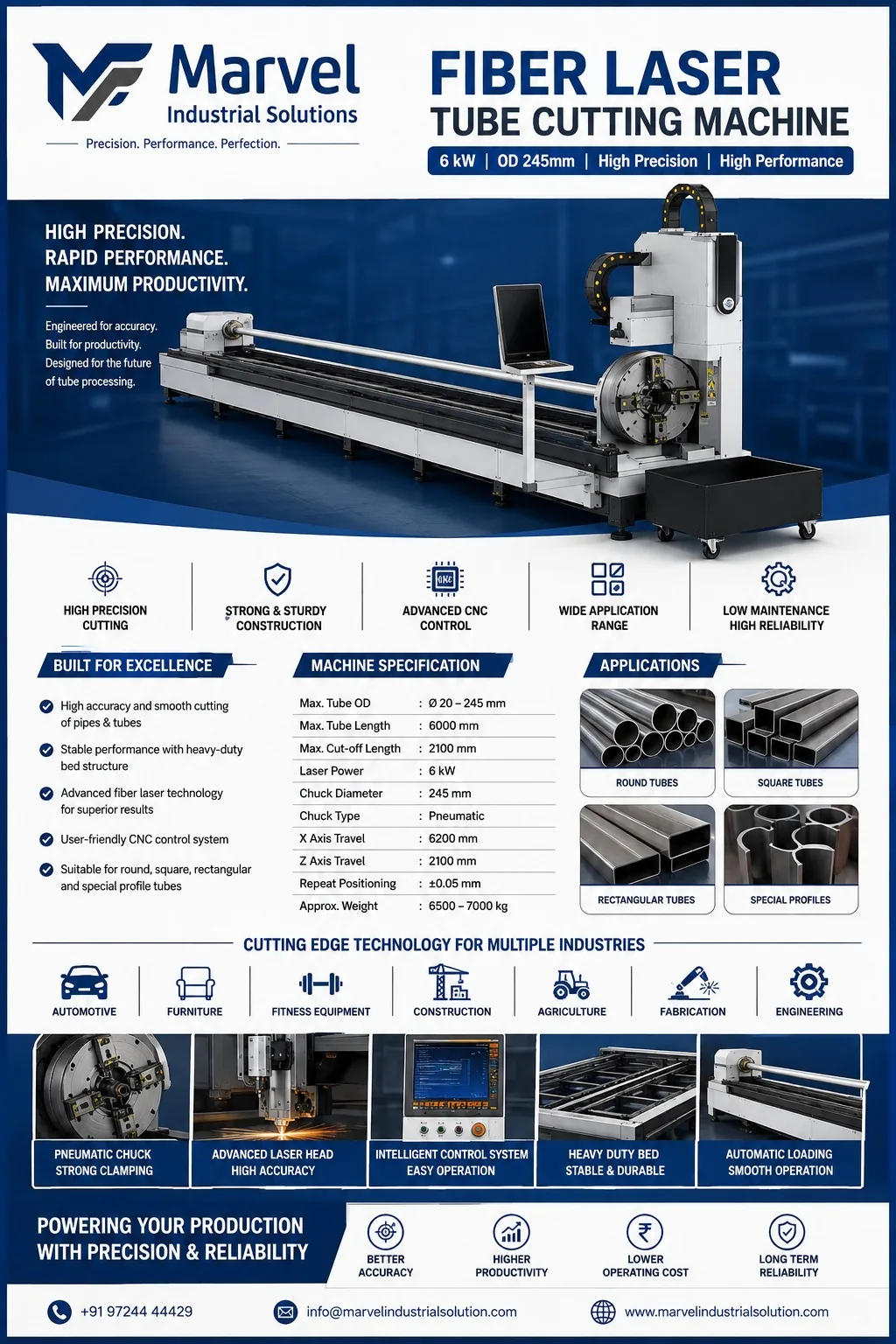
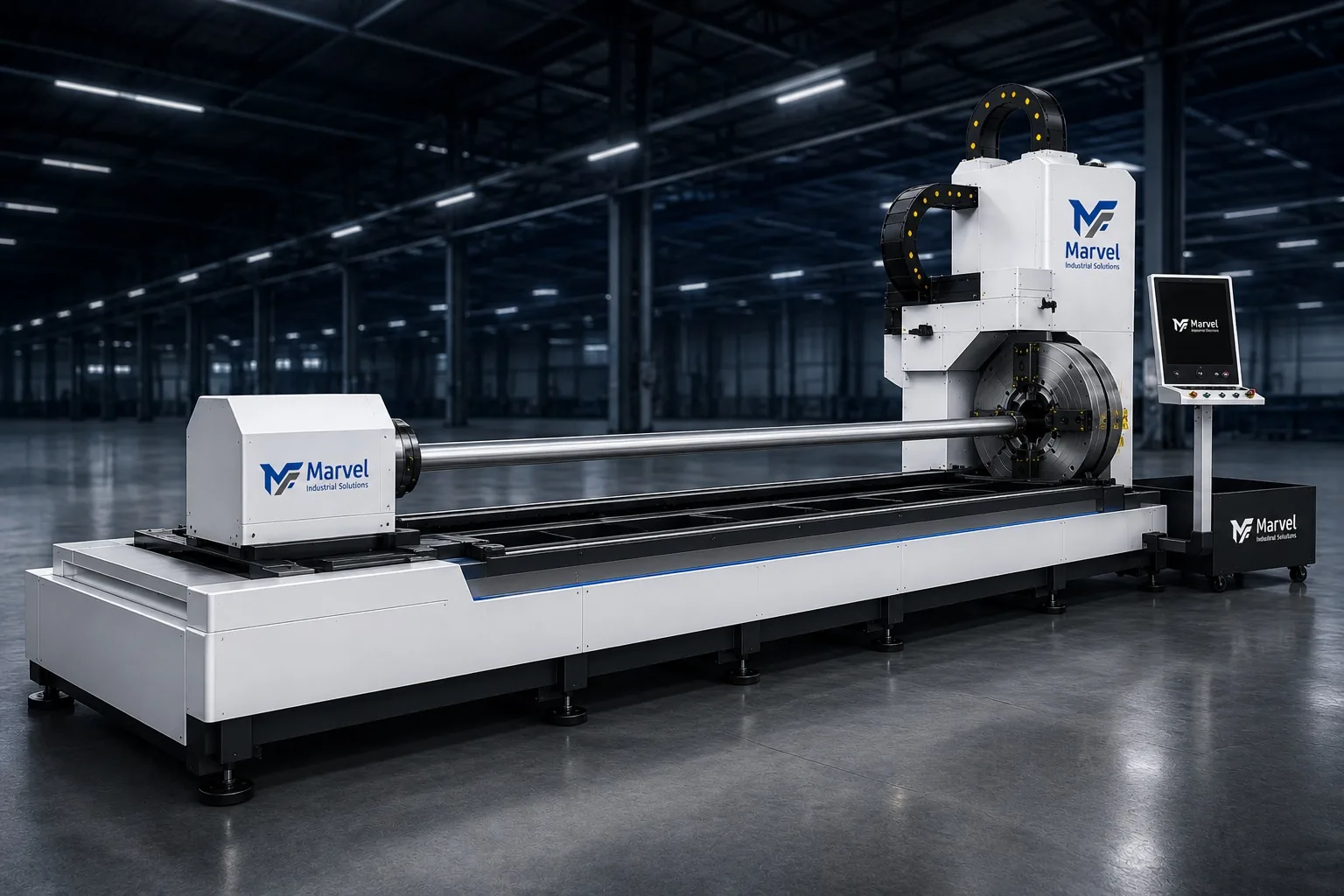
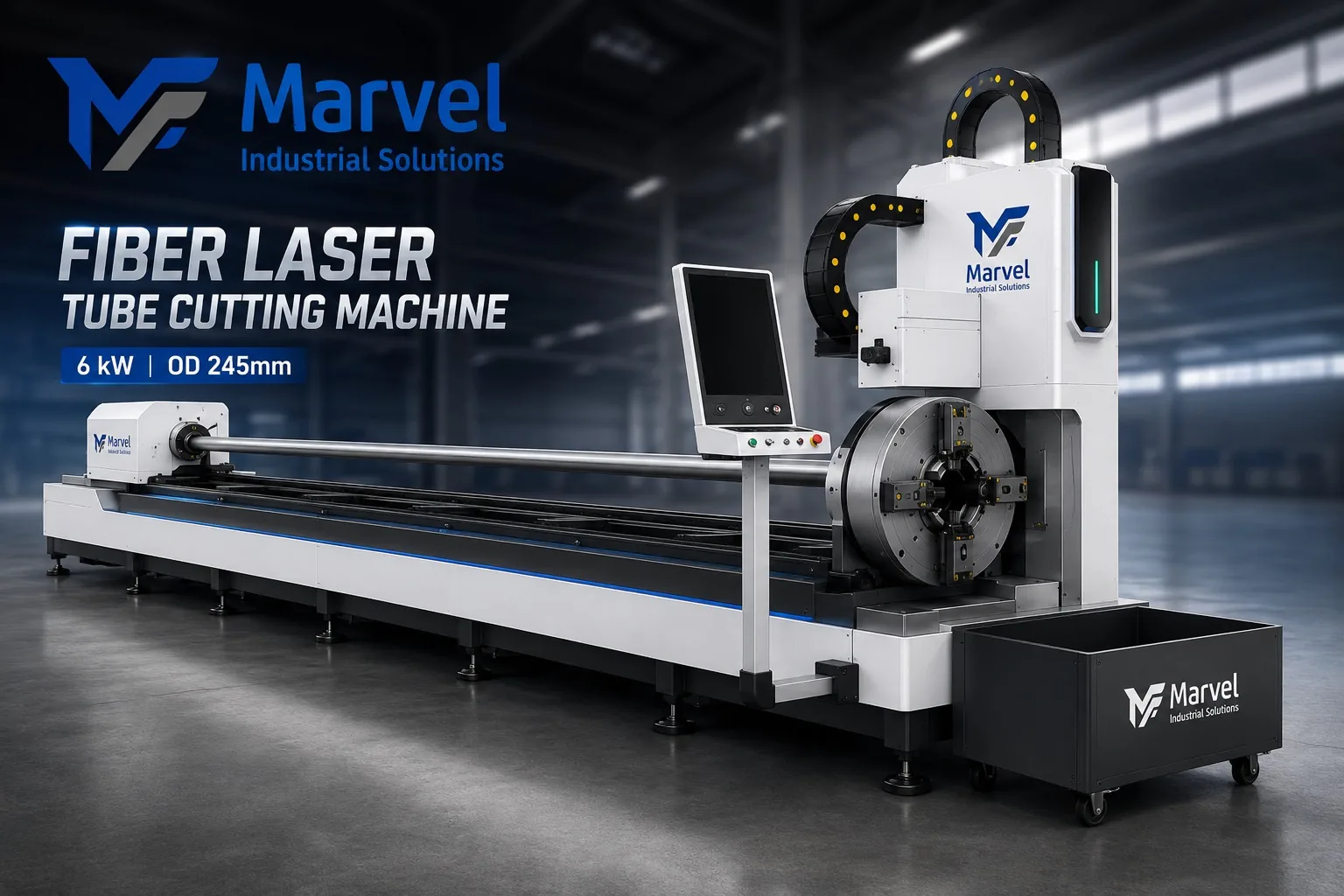
A laser tube cutting machine is a CNC-controlled industrial system designed to cut metal tubes, pipes and structural profiles using a focused fiber laser beam. Unlike a conventional saw that primarily separates material at a single plane, a tube laser rotates and positions the workpiece while coordinating the cutting head along a programmed path.
Depending on the machine, chuck and software configuration, it can perform straight cuts, angled cuts, holes, slots, contours, notches, joint preparation and complex profiles. This makes it useful when parts need accurate features on multiple faces or around the circumference of a tube.
Eliminating repeated transfers between machines can reduce setup time and accumulated positioning error. The finished tube may leave the machine ready for bending, assembly or welding, although deburring and inspection requirements depend on material, geometry and quality standards.
Practical Tip: Evaluate a tube laser with your real CAD drawing. A straight cut does not test small holes, joints, corners, piercing time or rotational accuracy.
How Does a Fiber Laser Tube Cutting Machine Work?
The operator loads a tube into the support and chuck system. Pneumatic or servo-controlled chucks clamp and rotate it while CNC axes position the tube relative to the cutting head. CAD/CAM software translates the part design into motion, rotation, piercing and cutting instructions.
- The raw tube or pipe is loaded manually or by an automatic bundle loader.
- The chuck clamps the material using a validated pressure and jaw arrangement.
- The operator imports or selects the required cutting program.
- The control positions and rotates the tube to the programmed datum.
- The cutting head focuses the laser and supplies the selected assist gas.
- Holes, slots, notches and end profiles are cut in sequence.
- The completed part is supported, discharged and collected for inspection.
Cut quality depends on laser power, focus, nozzle centring, assist gas, tube straightness, wall thickness, vibration control and the quality of the cutting parameters. Long or thin-wall tubes need suitable supports to prevent sagging and movement during rotation.
Key Features of a Laser Tube Cutting Machine
High cutting accuracy
Fiber laser technology creates a narrow kerf and accurately follows programmed geometry. Precision features can reduce secondary drilling and machining, but realistic tolerance should be confirmed across the complete tube length and profile range.
CNC-controlled production
CNC control coordinates linear travel, tube rotation, cutting-head height and process settings. Approved programs allow repeat orders to be produced consistently and reduce dependence on manual marking.
Automatic chuck system
The chuck is one of the most important mechanical systems. It must centre, clamp and rotate round or shaped profiles without excessive deformation. Buyers should compare clamping range, rotational accuracy, speed, jaw changeover and maintenance accessibility.
Multiple profile capability
Many machines process round, square and rectangular tubes. Compatible models may also support oval sections, channels, angles and other profiles. Maximum circumscribed diameter is not the only limit; minimum size, wall thickness, weight per metre and profile geometry also matter.
Complex shape cutting
Laser cutting can create slots, fish-mouth joints, tabs, locating holes and interlocking features directly in the tube. Thoughtful design for laser cutting can make assemblies self-locating and reduce welding fixture complexity.
High-speed processing
Fiber lasers are particularly productive on thin and medium wall tubes. Actual output is affected by material, wall thickness, profile, power, assist gas, number of pierces and part length. Total part cycle time is a more useful benchmark than maximum line speed.
Material utilisation
Tube nesting software can sequence components along standard stock lengths and manage remnants. Reducing the unusable front and tail sections is important when processing stainless steel, aluminium or expensive profiles.
Automation options
Bundle loading, single-tube loading, automatic unloading, part collection and production monitoring can reduce manual handling. Automation should match the variety, volume and weight of the product mix rather than being selected only as an optional feature.
Materials Suitable for Laser Tube Cutting
Mild steel
Mild steel tube is common in frames, machinery, agricultural equipment, automotive assemblies and general fabrication. Oxygen, nitrogen or air may be used depending on thickness, edge finish and downstream coating requirements.
Stainless steel
Stainless tubes are used in food processing, pharmaceuticals, architecture, furniture and industrial equipment. Nitrogen is often selected to produce a clean, oxide-free edge where appearance or weld quality matters.
Aluminium
Aluminium tube combines low weight with corrosion resistance and is used in transportation, furniture and engineered structures. Alloy, wall thickness, support and high-pressure assist gas must be considered.
Brass and copper
Compatible fiber systems can process reflective brass and copper tubes. The source and cutting head require suitable back-reflection protection, and production should be validated with the exact alloy and geometry.
Laser Tube Cutting Machine Applications
| Industry | Typical Parts | Main Benefit |
|---|---|---|
| Automotive | Frames, brackets, supports and fabricated assemblies | Repeatable features and fast batch production |
| Metal fabrication | Custom frames, pipe parts and weldments | Combines cutting, drilling and notching |
| Furniture | Chairs, tables, racks and shelving | Accurate joints and visible finish |
| Construction | Railings, canopies and modular structures | Flexible profile and angle cutting |
| Agriculture | Machine frames, guards and supports | Reliable mixed-profile processing |
| Fitness equipment | Exercise frames and adjustment features | Accurate holes and tube joints |
| Industrial machinery | Machine bases, guards and conveyors | Faster assembly and design flexibility |
Advantages of Fiber Laser Tube Cutting
Fewer manufacturing processes
Conventional production may require sawing, drilling, milling, punching and notching on separate equipment. Combining features in one CNC cycle reduces queues, work-in-progress and material movement. It also simplifies traceability because fewer setups influence the final part.
Better repeatability
Once the program, material and parameters are approved, components can be produced with consistent geometry. Repeatability is valuable for kits and welded assemblies where several tube parts must locate correctly.
Reduced repetitive labour
Automation reduces manual marking, repositioning and repetitive cutting. Skilled operators remain essential for programming, setup, inspection, maintenance and production control, but their time can be applied to higher-value tasks.
Faster assembly and welding
Tabs, slots and shaped end connections help parts fit together. Accurate fit-up can reduce fixture adjustment, welding gaps and rework. Designers should involve production teams so joint features remain practical to cut and weld.
Flexible production
Changing the CNC program allows manufacturers to move between products without dedicated hard tooling for every feature. That supports prototypes, custom jobs and repeat batches on the same system.
Laser Tube Cutting vs Conventional Processing
| Feature | Laser Tube Cutting | Conventional Processing |
|---|---|---|
| Accuracy | High, CNC controlled | Depends on machines and setups |
| Complex profiles | Excellent programmed flexibility | Multiple operations may be required |
| Holes and slots | Integrated in the cutting cycle | Usually drilled or punched separately |
| Automation | High, with loading options | Low to medium |
| Repeatability | High after process validation | Process and fixture dependent |
| Tool wear | No physical cutting tool at the beam | Saw blades, drills and mills wear |
| Design changes | Primarily software/program changes | May need fixtures or tooling |
| Production flow | Several features in one machine | Parts may visit multiple machines |
Conventional processing can remain economical for simple, low-volume straight cuts or very heavy sections. The right process depends on geometry, tolerance, volume, material and total production cost.
How to Choose the Right Laser Tube Cutting Machine
1. Tube diameter and profile size
List the minimum, regular and maximum round diameter and the diagonal dimension of square and rectangular sections. Confirm whether channels, angles or special profiles are required.
2. Tube length and weight
Match the bed, supports and loader to standard stock length. Include the heaviest section and the longest finished part, not only the raw length.
3. Material and wall thickness
Prepare a production matrix showing material grades and the percentage of work at each thickness. Maximum capability should not be confused with reliable daily production thickness.
4. Laser power
Common configurations may include 1500W, 2kW, 3kW, 6kW and higher. More power can improve productivity on suitable material, but it also changes investment, electrical load, assist gas and extraction needs. Read the fiber laser power selection guide and cutting thickness chart.
5. Chuck quality and layout
Compare chuck quantity, centring, clamping stability, remnant length and support system. Two- or three-chuck configurations may improve control or reduce tail waste for particular applications.
6. Tube software
Software should support profile libraries, seam orientation when required, nesting, collision avoidance, common-line strategies, part simulation and practical operator workflow. Request a programming demonstration using your drawing.
7. Automation level
Automatic bundle loading supports high-volume standard profiles, while flexible manual or semi-automatic loading can suit mixed small batches. Include unloading and safe part collection in the analysis.
8. Service and technical support
Evaluate installation, training, preventive maintenance, remote diagnostics, spare parts and response capability. Machine uptime depends on the supplier’s support as well as the hardware.
Buying Tip: Send representative drawings, tube sizes and daily quantities before asking for a quotation. This allows the chuck, power and automation to be selected for real production.
What Determines Laser Tube Cutting Machine Price in India?
Laser tube cutting machine price in India varies according to laser source power, maximum tube diameter and length, chuck quantity, servo system, cutting head, CNC control, software licences, bundle loader, unloading system, extraction, safety configuration, installation and service scope.
A lower purchase price does not always mean lower cost per part. Compare machine utilisation, remnant waste, programming time, loading labour, consumable life, electricity, gases, maintenance and expected uptime. A higher-capacity system produces a return only when the order mix uses that capability.
| Price Factor | Why It Matters |
|---|---|
| Laser power | Influences thickness capacity, speed and utility requirements |
| Chuck capacity | Defines profile size, weight and rotational control |
| Bed and loading length | Determines raw stock and finished-part handling |
| Automation | Reduces handling but adds capital and floor-space needs |
| Software | Affects programming speed, nesting and profile support |
| Service package | Influences commissioning, training and long-term uptime |
Machine Acceptance and Installation Checklist
- Confirm tube/profile range, weight and wall-thickness matrix
- Approve sample cuts using actual drawings and materials
- Measure repeatability, feature location and finished-part quality
- Verify electricity, gas, compressed air, extraction and foundation
- Review loader clearance, material flow and operator access
- Document training, preventive maintenance and spare parts
- Define commissioning and acceptance responsibilities
Why Choose Marvel Industrial Solution?
Marvel Industrial Solution provides industrial laser machines and automation systems configured for modern manufacturing. The team supports application evaluation, machine selection, installation, operator training, process development and Pan-India after-sales requirements.
Explore the dedicated Laser Tube Cutting Machine, Single Table Fiber Laser Machine, Exchange Table Fiber Laser Machine, Auto Feeding Fiber Laser Machine, Laser Welding Machine, Gantry Robot System and Automatic Material Handling System.
Laser Tube Cutting Machine Manufacturer and Supplier in India
When contacting a manufacturer or supplier, prepare material type, tube shape, minimum and maximum diameter or profile size, raw length, wall thickness, typical drawings, daily quantity and automation requirement. Accurate input allows a suitable system to be recommended instead of comparing machines only by wattage.
A production discussion should also cover future products, available floor space, crane or forklift access, electrical capacity, gas infrastructure and downstream welding. These factors can determine whether the machine delivers its planned output after installation.
Frequently Asked Questions
What is a laser tube cutting machine?
It is a CNC system using a focused laser to cut tubes, pipes and profiles, including holes, slots, notches and contours.
Which materials can it cut?
Compatible systems process mild steel, stainless steel, aluminium, brass and copper within validated power and thickness ranges.
Can it cut round and square tubes?
Yes. Many systems process round, square and rectangular profiles; special-section support depends on chuck and software.
Can it make holes and slots?
Yes. Programmed holes, slots and joint features can be integrated into the cutting cycle.
What laser power should I choose?
Select power from regular material, wall thickness, speed, finish and volume rather than maximum wattage alone.
Is it suitable for mass production?
Yes. CNC repeatability and automatic loading options suit medium- and high-volume production.
What is its price in India?
Price varies with power, tube capacity, chucks, software, automation, safety and service scope.
Can tube laser cutting reduce welding time?
Accurate locating features and joints can improve fit-up and reduce manual alignment.
Do I need automatic loading?
It is useful for long shifts and standard high-volume profiles; varied low-volume work may suit manual loading.
What details are needed for a quotation?
Provide material, profile, size, wall thickness, length, drawings, daily quantity and required automation.
Conclusion
A laser tube cutting machine can transform tube and pipe fabrication by combining several conventional operations into one accurate CNC process. The right system improves throughput, repeatability, material use and flexibility while simplifying complex components.
The best machine is the one whose tube capacity, laser source, chuck system, software, automation and support match actual production. Validate it with representative parts and calculate total cost per accepted component.
Looking for a laser tube cutting machine for your factory? Share your tube size, material, wall thickness, drawings and production target with Marvel Industrial Solution.
Request a Configuration & Quote