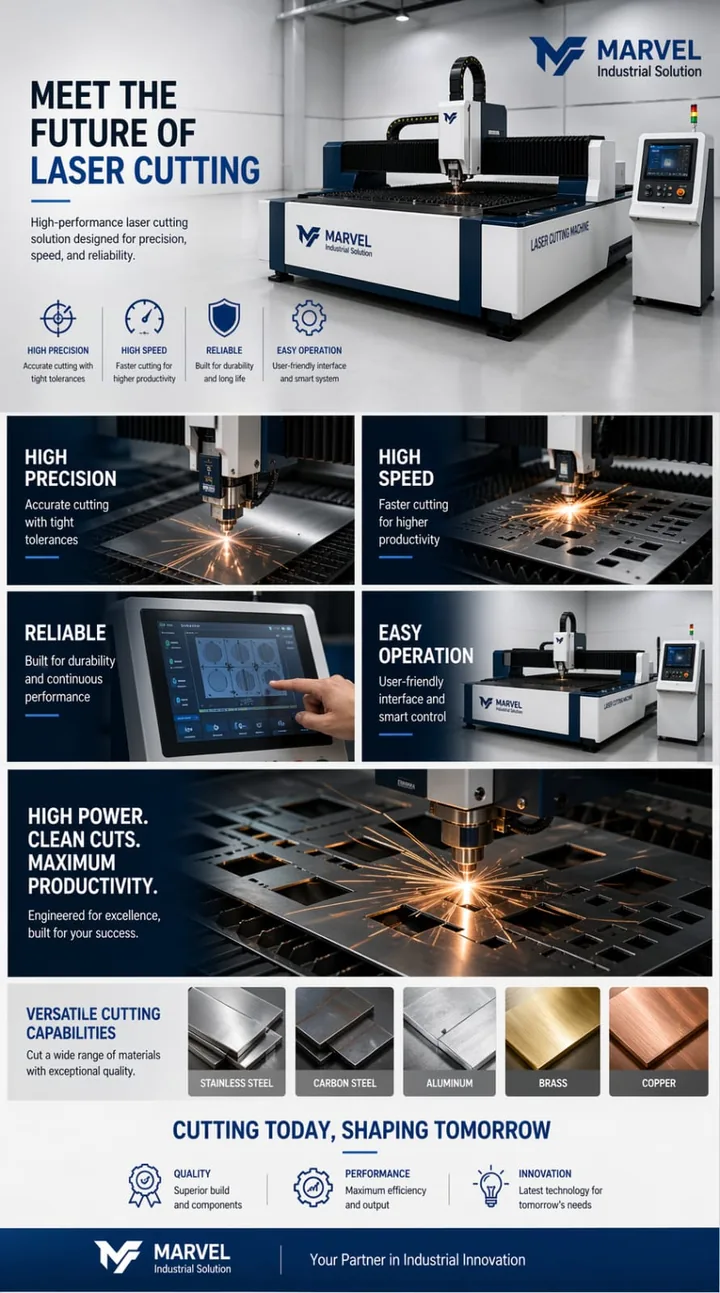
Cutting thickness affects throughput, edge quality, gas use, piercing time and the orders a factory can accept. Wattage matters, but the complete machine and process determine real capacity.
These values are approximate. Results vary with source output, material grade, optics, assist gas, machine stability, parameters and required edge finish. Validate the exact plate and production drawing before purchase.
What Determines Fiber Laser Cutting Thickness?
Power and beam quality determine available energy and focus. Material type and quality matter because MS, SS, aluminium, brass and copper absorb and conduct heat differently. Rust, coatings, alloy and flatness can reduce repeatability.
Assist gas removes molten metal: oxygen adds reactive heat for MS, while nitrogen protects SS and aluminium from oxidation. Optics, focus and nozzle alignment determine how energy and gas enter the kerf. Machine rigidity, servo response, height control, cutting speed and piercing strategy complete the process.
Pro Tip: Maintain a validated parameter library by material grade, thickness, gas and nozzle. Record speed, edge quality and consumable life.
Complete Fiber Laser Cutting Thickness Chart
Maximum means separation may be possible under favourable conditions. Production range means repeatable cutting at commercially acceptable speed, quality and cost.
Mild Steel (MS)
| Power | Maximum | Production Range |
|---|---|---|
| 1500W | 10 mm | 1–6 mm |
| 2kW | 12 mm | 1–8 mm |
| 3kW | 18 mm | 2–12 mm |
| 4kW | 20 mm | 3–14 mm |
| 6kW | 25 mm | 4–20 mm |
| 12kW | 40 mm | 6–30 mm |
Stainless Steel
| Power | Maximum | Production Range |
|---|---|---|
| 1500W | 5 mm | 1–3 mm |
| 2kW | 8 mm | 1–5 mm |
| 3kW | 12 mm | 1–8 mm |
| 4kW | 16 mm | 2–10 mm |
| 6kW | 20 mm | 2–14 mm |
| 12kW | 30 mm | 3–22 mm |
Aluminium
| Power | Maximum | Production Range |
|---|---|---|
| 1500W | 4 mm | 1–2 mm |
| 2kW | 6 mm | 1–4 mm |
| 3kW | 8 mm | 1–6 mm |
| 4kW | 10 mm | 2–8 mm |
| 6kW | 16 mm | 2–12 mm |
| 12kW | 25 mm | 3–18 mm |
Brass and Copper
| Power | Brass Maximum | Copper Maximum |
|---|---|---|
| 1500W | 4 mm | 2 mm |
| 2kW | 5 mm | 4 mm |
| 3kW | 8 mm | 6 mm |
| 4kW | 10 mm | 8 mm |
| 6kW | 12 mm | 10 mm |
Brass and copper are reflective, so confirm source protection and cutting-head compatibility. Aluminium alloys vary, and nitrogen demand rises quickly with stainless thickness.
Maximum vs Production Thickness
A maximum cut may be slow, create more dross and require longer piercing. Production thickness remains stable across a shift. A 6kW machine may cut 25 mm MS at its limit, while 16–20 mm is a more practical daily range depending on geometry and finish.
Common Mistake: Buying from the largest brochure number. Size the machine around the thickness consuming most monthly cutting hours.
How Power Affects Productivity
| Power | Best Fit | Consideration |
|---|---|---|
| 1500W–2kW | Thin sheet | Low investment; limited thick work |
| 3kW–4kW | General fabrication | Balanced flexibility |
| 6kW | Medium-sheet production | Needs gas and workload |
| 12kW+ | High-volume heavy plate | Handling can become the bottleneck |
Higher power can increase speed and reduce piercing time. When loading limits output, consider an Exchange Table Machine, Auto Feeding Machine or Automatic Material Handling System.
Did You Know? Faster cycles can reduce energy per finished part even when connected load is higher.
Which Laser Power Should You Buy?
1500W
Small workshops, decorative fabrication and kitchen equipment using thin sheet.
3kW
General fabrication, agriculture and industrial components with thin-to-medium material.
6kW
OEM suppliers, production factories and stainless fabricators processing medium thickness daily.
12kW+
Steel service centres, structural work and heavy fabrication with planned power, gas and handling.
Buying Tip: Plan for growth, but compare machine payment, gas, electricity, labour and realistic billable hours before purchasing unused power.
Oxygen vs Nitrogen
| Factor | Oxygen | Nitrogen |
|---|---|---|
| Best use | Thicker MS | SS, aluminium, clean edges |
| Action | Reactive; adds heat | Inert; ejects melt |
| Edge | Oxide layer | Bright, oxide-free |
| Flow | Generally lower | Higher |
| Downstream | May need oxide removal | Often less preparation |
What Reduces Cutting Capacity?
- Dirty lens or damaged, off-centre nozzle
- Wrong focus, speed or piercing parameters
- Low gas purity, pressure or delivery flow
- Rusty, coated, warped or inconsistent plate
- Machine vibration or poor height control
- Inadequate maintenance
Use the Fiber Laser Maintenance Checklist before increasing power to compensate for an unstable process.
Fiber Laser vs Plasma
| Factor | Fiber Laser | Plasma |
|---|---|---|
| Strength | Thin-to-medium precision | Medium-to-thick economy |
| Accuracy/kerf | High/narrow | Lower/wider |
| Heat zone | Generally smaller | Generally larger |
| Capital cost | Higher | Typically lower |
| Applications | Precision parts and fine detail | Structural and heavy plate |
See the full Laser Cutting vs Plasma Cutting comparison.
Industries
Automotive and electrical-panel manufacturers value speed and fine features. Furniture and kitchen equipment need clean stainless edges. Agriculture and general fabrication process mixed MS. Construction, railway, defence and heavy engineering prioritise thick plate, reliable piercing and material handling.
Frequently Asked Questions
How thick can 1500W cut?
About 10 mm MS, 5 mm SS, 4 mm aluminium/brass or 2 mm copper as approximate maxima.
Can 3kW cut 20 mm MS?
Its typical maximum is around 18 mm; choose more power for regular 20 mm work.
Which gas is best?
Oxygen for thicker MS, nitrogen for clean SS and aluminium, and air for selected thin-sheet economy.
Can fiber laser cut copper and brass?
Yes, with compatible protected equipment.
What power cuts 25 mm MS?
6kW may reach it at maximum; 12kW offers better production margin.
How fast is 6kW?
It depends on material, thickness, gas and geometry; benchmark a sample nest.
Is 3kW enough for fabrication?
Often yes for thin-to-medium work.
Which power is best for aluminium?
3kW suits medium work; 6kW adds capacity and speed.
Does more power use more electricity?
Usually, though shorter cycles can lower energy per part.
How do I choose a machine?
Document material, regular thickness, volume, finish, utilities and growth, then sample-cut real parts.
Can one machine cut all metals?
One compatible machine can process several metals at different capacities.
What affects quality?
Optics, focus, nozzle, gas, material, speed and rigidity.
Is maximum thickness guaranteed?
No; process conditions and finish requirements vary.
What is production thickness?
The repeatable commercial range, not the one-off limit.
What maintenance helps?
Clean optics, centred nozzles, gas delivery, chiller service and inspections.
Why Choose Marvel Industrial Solution?
Marvel Industrial Solution supports customized selection, automation, installation, training and Pan-India after-sales service. Explore the Single Table Fiber Laser Machine, Exchange Table Machine, Laser Welding Machine, Laser Marking Machine, Gantry Robot System, Stamping Press Transfer Robot and Auto Metal Polishing Machine.
Also read the Fiber Laser Buying Guide, How to Select Laser Power and Best Fiber Laser Cutting Machine guide.
Conclusion
A fiber laser cutting thickness chart is a planning tool, not a guarantee. Select power from daily production, finish, geometry and cycle time, then confirm with controlled samples.
Share your material mix, regular thickness and production target for a practical recommendation.
Request a Cutting Trial