The best assist gas for a fiber laser depends on the metal, thickness, required appearance, downstream operation and local utility cost. This guide explains the practical trade-offs so buyers and operators can choose on evidence rather than habit.
What Is Assist Gas in Fiber Laser Cutting?
The laser beam supplies concentrated energy that melts or reacts with the workpiece. Assist gas passes through the cutting-head nozzle and ejects molten material from the kerf. Without the correct gas flow, molten metal can remain attached as dross, the kerf can close, and the cut can become unstable.
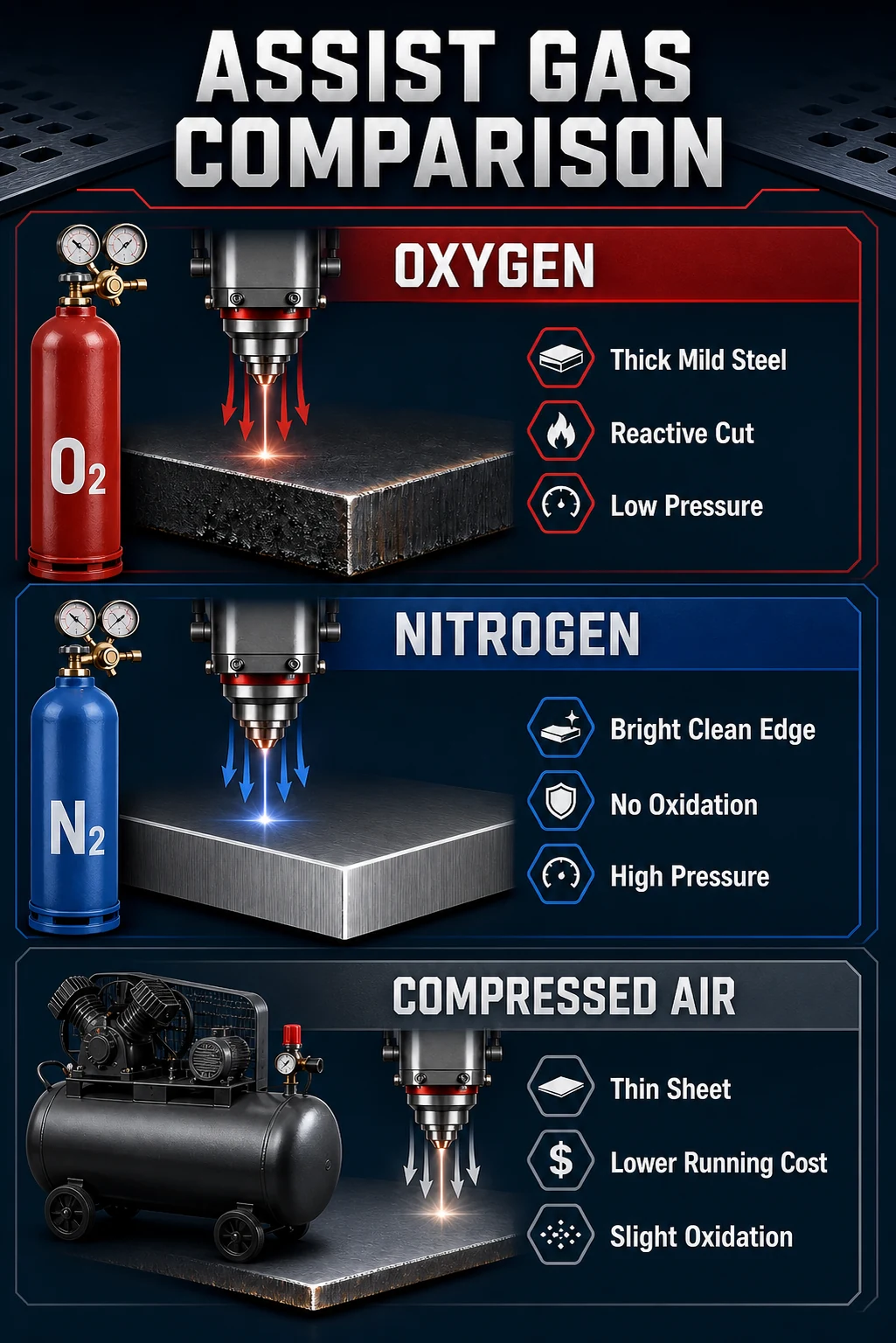
Assist gas also influences heat transfer and chemistry at the cut edge. Oxygen reacts with iron and adds heat. Nitrogen is inert and suppresses oxidation. Compressed air contains mostly nitrogen with oxygen and other trace gases, offering a compromise between purchased-gas cost and edge quality. The gas stream also helps reduce smoke and spatter reaching the protective window, although clean optics still depend on correct nozzle stand-off and maintenance.
Pro Tip: Match the assist gas to the material and finish required—not just the lowest quoted gas price.
Types of Fiber Laser Assist Gas
Oxygen (O₂): reactive cutting
Oxygen supports an exothermic oxidation reaction when cutting carbon steel. The added chemical heat helps process thicker mild steel with less laser power and generally at relatively low pressure. High purity and stable delivery still matter: contamination or pressure variation can cause inconsistent scale, roughness or loss of cut.
The trade-off is a dark iron-oxide layer. Before powder coating, painting or critical welding, fabricators may need to grind or otherwise remove this layer. Oxygen is therefore valuable where thickness and cost matter more than a bright edge.
Nitrogen (N₂): inert, oxide-free cutting
Nitrogen does not support combustion. High-pressure nitrogen mechanically drives molten metal through the kerf and shields the hot edge from atmospheric oxygen. It can produce a bright, clean surface on stainless steel and aluminium, making it the preferred choice for visible kitchen equipment, elevators, architectural metal and food-processing components.
Nitrogen cutting needs much higher pressure and flow than oxygen, especially as thickness and nozzle diameter increase. Purchased cylinders can become expensive at production scale, so bulk liquid supply or on-site nitrogen generation may be evaluated.
Compressed air: practical mixed-gas cutting
Dry compressed air is approximately 78% nitrogen and 21% oxygen. Its oxygen content provides some reactive assistance, while the nitrogen-rich mixture limits oxidation compared with pure oxygen. Air is increasingly used for thin mild steel, stainless and aluminium when a slight edge oxide or colour change is acceptable.
A suitable air system is more than a general workshop compressor. It needs adequate pressure and continuous flow, an air receiver, refrigerated or desiccant dryer, coalescing filters, oil control and correctly sized piping. Moisture or oil can damage optics, destabilise the cut and create expensive downtime.
Oxygen vs Nitrogen vs Air Comparison
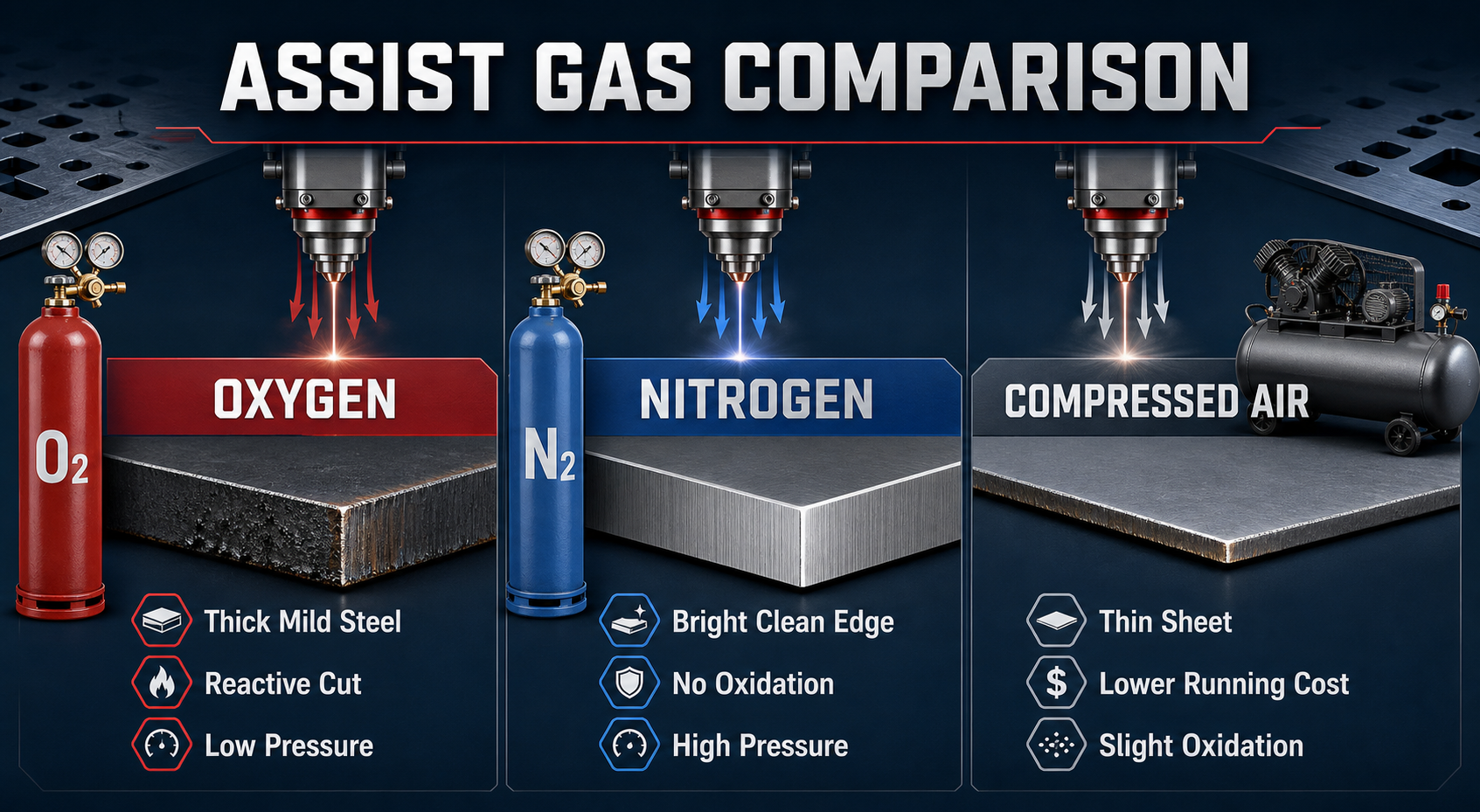
| Feature | Oxygen | Nitrogen | Compressed Air |
|---|---|---|---|
| Surface finish | Dark, oxidised | Bright, clean | Industrial finish, some colour |
| Cutting action | Reactive | Inert melt ejection | Mixed reactive/inert |
| Edge oxidation | High | Very low | Low to moderate |
| Typical quality | Good MS edge | Premium finish | Good functional finish |
| Running-cost tendency | Medium | High | Low after system investment |
| Consumption tendency | Lower flow | High flow | Compressor-based |
| Best materials | Mild steel | SS, aluminium, brass, copper | Thin MS, SS and aluminium |
| Best thickness | Medium to thick MS | Thin to medium premium work | Thin sheets |
| Pressure tendency | Low | High | High |
| Maintenance focus | Regulator and clean supply | High-pressure delivery | Compressor, dryer and filters |
Pressure values should come from the machine supplier’s validated parameter table. Static regulator pressure is not enough; dynamic pressure and flow at the nozzle must remain stable while cutting.
Surface Finish Comparison
Oxygen edges
Oxygen-cut MS normally has a dark oxide surface. It can be suitable for structural parts and welding after cleaning, but oxide may reduce paint or powder-coat adhesion. A part that looks acceptable at the cutting machine may therefore incur downstream labour.
Nitrogen edges
Nitrogen can leave bright stainless and aluminium edges with little discoloration, reducing brushing, grinding or pickling. For restaurant equipment, elevator panels and decorative components, avoiding a visible oxide layer can justify the higher gas bill.
Air-cut edges
Air usually produces slight oxidation and a less premium appearance than nitrogen. It is often entirely acceptable for hidden brackets, electrical-panel internals, agricultural parts and components that will be painted or otherwise finished.
Expert Advice: Nitrogen is ideal for premium stainless steel applications where appearance matters and oxide removal would add labour.
Cutting Speed Comparison
Oxygen is effective on thicker mild steel because oxidation contributes energy. This does not mean it is always fastest: on thin MS, nitrogen or air can support higher travel speeds because the process is not limited by the same controlled oxidation behaviour. Nitrogen is preferred on stainless because it combines speed with a non-oxidised edge, provided the laser power and gas flow can fully eject the melt.
Air can approach nitrogen-like productivity on selected thin material, with small differences depending on power, thickness and quality target. Higher-power lasers can make air more attractive by providing sufficient melt energy without relying on pure oxygen. Compare complete nested-sheet cycle time, piercing and rejected parts—not a single straight-line speed.
Did You Know? Oxygen supports combustion, allowing thicker mild steel cutting with lower laser power, but controlled oxidation can limit speed on some thin-sheet jobs.
Operating Cost Comparison
Gas price is only one line in fiber laser operating cost. Include cylinder rental and handling, manifold labour, bulk-tank rental, evaporation losses, nitrogen-generator electricity, compressor electricity, filters, dryers, service, floor space, financing and downstream edge cleaning.
| Cost Element | Oxygen | Nitrogen | Air |
|---|---|---|---|
| Initial equipment | Low to medium | Medium; high for generation | High for cutting-grade compressor package |
| Purchased gas | Moderate, lower flow | Often highest | No purchased process gas |
| Electricity | Low supply-system load | Higher with generator | Compressor and dryer load |
| Maintenance | Regulators and delivery | Delivery or generator service | Compressor, drains, dryer and filters |
| Secondary cleaning | Can be significant | Usually lowest | Application-dependent |
| Best ROI case | Regular thicker MS | Premium finish or avoided rework | High-volume thin functional parts |
Do not publish a universal rupee-per-hour figure without local quotations and measured consumption. Cylinder and electricity pricing varies by region and contract. A useful calculation is total monthly gas-system cost divided by accepted cutting hours, then add any cleaning and rejection cost.
Buying Tip: If most work is thin mild steel and the finish permits it, a properly sized, high-quality air compressor system can significantly reduce purchased-gas cost.
Gas Consumption
Nozzle diameter has a strong effect on flow. Thickness, pressure, piercing strategy, part geometry, laser power and machine efficiency also matter. Frequent long pierces, leaks and oversized nozzles can increase cost without improving the finished part.
| Gas | Typical Consumption Pattern | Cost Level | Control Priority |
|---|---|---|---|
| Oxygen | Lower pressure and flow | Medium | Purity and stable low-pressure control |
| Nitrogen | High pressure and high flow | High | Nozzle selection, leaks and bulk capacity |
| Air | Continuous compressor output | Low gas cost | Energy, dryness, oil removal and filters |
Which Gas Should You Use for Each Metal?
Mild steel
Best for thicker MS: oxygen. The reactive process improves thickness capability. Air can be attractive for thin MS where speed and lower gas cost matter and slight oxidation is acceptable. Nitrogen is used when an oxide-free edge is specifically required.
Stainless steel
Best for premium finish: nitrogen. It prevents chromium-rich edge oxidation and supports bright appearance. Dry air is a practical alternative for thin internal parts or painted components.
Aluminium
Best: nitrogen. It limits oxidation and produces a clean edge. Air may suit thin functional aluminium when colour change is acceptable. Confirm alloy and thickness through samples.
Brass and copper
Preferred: nitrogen. These reflective materials require a compatible laser source, protective cutting head and validated settings. Nitrogen avoids adding oxygen to the hot edge and usually supports better appearance.
Industry Recommendations
| Industry | Typical Priority | Common Choice |
|---|---|---|
| Sheet-metal job shops | Flexibility and cost | All three, job-dependent |
| Kitchen equipment | Bright stainless finish | Nitrogen |
| Automotive/OEM | Repeatability and cycle time | Nitrogen or air; oxygen for MS |
| Elevators/decorative metal | Visible edge | Nitrogen |
| Electrical panels | Thin-sheet cost | Air or nitrogen |
| Agriculture equipment | Functional MS parts | Oxygen or air |
| Furniture | Appearance and speed | Nitrogen or air |
| Heavy engineering | Thick MS capacity | Oxygen |
Advantages and Disadvantages
Oxygen
- Strong thickness capability on mild steel
- Lower pressure and flow than nitrogen
- Creates an oxide layer and dark edge
- May require cleaning before coating or welding
Nitrogen
- Bright, oxide-free premium edge
- Preferred for stainless and aluminium
- High flow can be expensive
- Needs capable high-pressure delivery
Compressed air
- Low purchased-gas cost and good thin-sheet productivity
- Useful across several common metals
- Slight oxidation and colour change
- Requires capital, electricity, drying and filtration
How Gas Selection Affects Profitability
A kitchen-equipment producer may pay more for nitrogen but save grinding and deliver a premium visible edge. An electrical-panel producer cutting internal brackets may reduce cost with air because slight oxidation has no commercial effect. A heavy-fabrication shop may use oxygen to accept thicker MS work without purchasing substantially more laser power.
Calculate accepted parts per shift, not only cutting speed. Scrap from an unstable gas supply, damaged protective windows from wet air, added cleaning, delayed welding and customer complaints can exceed the gas saving. Correct gas selection supports throughput, consumable life, predictable electricity use and customer satisfaction.
Common Assist-Gas Mistakes
| Mistake | Consequence | Solution |
|---|---|---|
| Oxygen on visible stainless | Oxide and extra cleaning | Use nitrogen for premium finish |
| Nitrogen on every job | Unnecessary operating cost | Test air or oxygen where finish permits |
| Incorrect pressure | Dross or unstable cut | Use validated dynamic settings |
| Poor gas purity | Colour and inconsistency | Specify and verify supply quality |
| Dirty filters/wrong nozzle | Restricted flow and poor kerf | Inspect and replace on schedule |
| Compressor without dryer | Moisture, optics risk and downtime | Install cutting-grade drying and filtration |
| Leaks or undersized pipe | Pressure drop and wasted energy | Test leaks and size for peak flow |
Common Mistake: Using oxygen on stainless steel can create oxide layers that reduce weld or coating quality and require additional cleaning.
Frequently Asked Questions
Which gas is best for fiber laser cutting?
Oxygen for thicker MS, nitrogen for premium SS and aluminium, and dry air for economical thin-sheet work.
Can compressed air replace nitrogen?
Yes on selected thin parts where slight oxidation is acceptable, but not where a bright oxide-free edge is mandatory.
Is oxygen cheaper than nitrogen?
Often at the machine because its flow is lower, but downstream oxide cleaning must be included.
Which gas gives the best finish?
Nitrogen generally gives the best bright edge on stainless and aluminium.
Can air cut stainless steel?
Yes, especially thin stainless for functional parts.
Which gas cuts fastest?
It depends on material, thickness, power and finish. Test a representative nest.
Does oxygen increase cutting thickness?
Yes on MS because oxidation adds heat.
What gas is best for aluminium?
Nitrogen for premium edges; dry air for selected cost-focused thin work.
What pressure is required?
Use the machine’s parameter table: oxygen is generally low pressure, nitrogen and air high pressure.
Does nitrogen prevent rust?
It prevents oxidation during cutting but does not permanently protect the part from corrosion.
How much gas does a laser consume?
Nozzle, pressure, thickness, cutting time and leaks determine consumption.
Can I switch gases during production?
Yes, with correct hardware, purging and separate parameter sets.
Which gas gives burr-free edges?
Nitrogen can give excellent edges, but focus, nozzle and parameters are equally important.
Is an air compressor enough?
Only if it provides specified flow, pressure, drying, filtration and oil control.
Which gas reduces operating cost?
Air often lowers gas cost on suitable thin work; calculate electricity, maintenance and finish requirements.
Why Choose Marvel Industrial Solution?
Marvel Industrial Solution supplies industrial-grade CNC fiber laser machines with application review, assist-gas optimisation, installation, process training, automation integration and Pan-India after-sales support. Machine recommendations are matched to material mix, finish and production volume rather than a single headline specification.
Explore the Single Table Fiber Laser Machine, Exchange Table Fiber Laser Machine, Auto Feeding Fiber Laser Machine, Laser Welding Machine, Laser Marking Machine, Gantry Robot System, Stamping Press Transfer Robot, Automatic Material Handling System and Auto Metal Polishing Machine.
For selection research, read the Fiber Laser Buying Guide, Fiber Laser Cutting Thickness Chart, How to Select Laser Power, Laser Cutting vs Plasma Cutting and Best Fiber Laser Cutting Machine guide.
Conclusion
In Oxygen vs Nitrogen vs Air laser cutting, no single gas is best for every job. Oxygen supports thicker mild steel, nitrogen delivers premium oxide-free edges, and cutting-grade compressed air can reduce cost on suitable thin sheets. Choose from the finished-part requirement, verify with production samples and calculate total cost per accepted component.
Share your material, thickness, finish standard and production volume. Marvel Industrial Solution can recommend a practical machine and assist-gas setup.
Request Process Guidance