
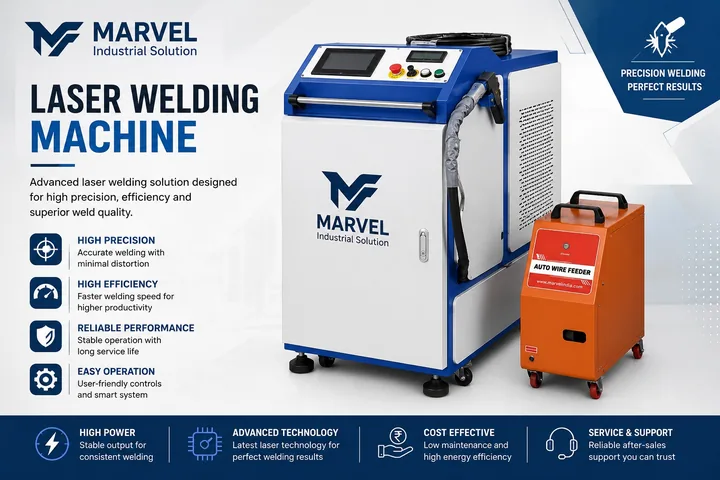
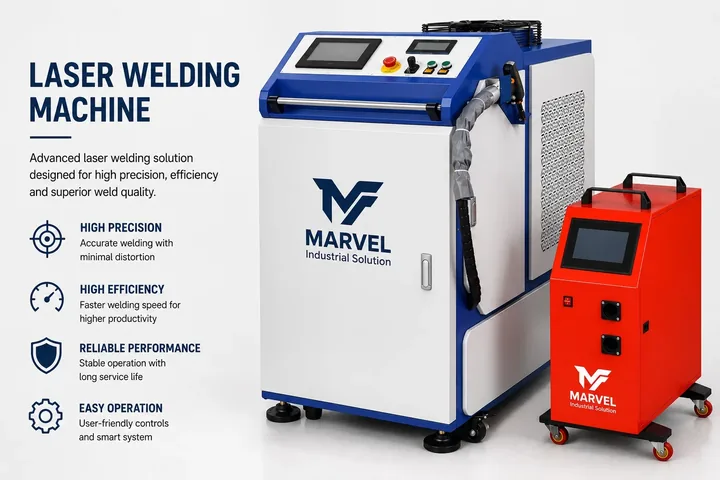
Laser welding has transformed modern metal manufacturing. Businesses are replacing or supplementing traditional welding methods with fiber laser welding for speed, precision, attractive weld finish and lower post-processing cost.
What Is a Laser Welding Machine?
A laser welding machine uses a focused laser beam to generate heat at the joint area and fuse metal parts together. The laser energy is concentrated, which allows precision welding with a small heat-affected zone, minimal distortion and clean weld appearance.
Laser welding can be used in handheld machines for flexible fabrication work or integrated into automated systems, CNC fixtures and robotic welding cells for repeat production.
How Does Laser Welding Work?
The process starts with laser beam generation. The beam is focused through optics onto the joint area, where metal melts and fuses. After the laser moves along the joint, the molten area solidifies and forms a strong weld. Shielding gas, focus, power, speed and fit-up all affect weld quality.
Why Industries Are Switching to Laser Welding
- Faster welding speed for suitable joints
- High precision and consistent weld quality
- Small heat-affected zone and lower distortion
- Reduced grinding, polishing and post-processing
- Better weld aesthetics for visible metal products
- Automation-ready workflow for repeated components
Materials Suitable for Laser Welding
| Material | Laser Welding Suitability |
|---|---|
| Stainless Steel | Excellent |
| Mild Steel | Excellent |
| Aluminum | Excellent |
| Brass | Good |
| Copper | Good |
| Titanium | Excellent |
| Galvanized Steel | Good |
| Nickel Alloys | Excellent |
Actual weldability depends on material thickness, surface condition, joint design, shielding gas, welding speed, operator training and machine configuration.
Top Laser Welding Machine Applications
1. Sheet Metal Fabrication
Sheet metal fabrication is one of the most practical laser welding uses. Cabinets, electrical enclosures, control panels, industrial equipment and sheet metal assemblies can benefit from clean welds, high productivity and reduced finishing.
2. Automotive Industry
Automotive manufacturers use laser welding for exhaust systems, chassis components, battery enclosures, fuel tanks, seat frames and electric vehicle components. The main advantages are strong joints, high repeatability and automation compatibility.
3. Stainless Steel Kitchen Equipment
Commercial kitchen equipment, sinks, food processing machinery and storage tanks need attractive and hygienic welds. Laser welding can reduce polishing time while improving visual finish.
4. Electrical and Electronics
Electrical cabinets, switchgear, control panels, busbars and battery components often require compact weld zones and controlled heat input. Laser welding helps protect precision parts and visible surfaces.
5. Medical Equipment
Medical devices, surgical instruments, stainless steel assemblies and precision components need clean, accurate welds. Laser welding can support high accuracy and reduced contamination when the process is properly controlled.
6. Aerospace Industry
Aerospace parts demand strength, tight tolerances and weight reduction. Laser welding can support aircraft components, turbine parts, lightweight structures and precision assemblies.
7. Furniture Manufacturing
Stainless steel furniture, decorative frames, office furniture and display racks often require smooth visible joints. Laser welding helps reduce grinding and improves production speed.
8. Agricultural Equipment
Agricultural machinery parts, frames, sheet metal parts and attachments need durable welds and efficient production. Laser welding can lower production cost for repeated metal assemblies.
9. Heavy Engineering
Industrial machinery, machine frames, equipment fabrication and structural components can benefit from consistent weld quality and better repeatability, especially when fixturing and automation are used.
10. Signage and Decorative Metal Work
Stainless steel signs, letters, decorative panels and architectural products need clean, visually appealing joints. Laser welding reduces finishing and helps preserve product appearance.
Laser Welding vs Traditional Welding
| Feature | Fiber Laser Welding | TIG/MIG Welding |
|---|---|---|
| Speed | Very high | Medium |
| Precision | Excellent | Good |
| Heat Input | Low | High |
| Distortion | Minimal | Higher |
| Post Processing | Minimal | More |
| Automation | Excellent | Limited to moderate |
| Operator Skill | Moderate with training | Higher |
| Operating Efficiency | High | Moderate |
Handheld vs Automated Laser Welding
| Handheld Laser Welding | Automated Laser Welding |
|---|---|
| Flexible for repairs and fabrication | Ideal for mass production |
| Portable and easier to set up | Higher throughput |
| Suitable for small batches | Consistent repeat quality |
| Good for varied components | Supports robotic integration |
Handheld laser welding is practical for flexible shop-floor use, repairs and medium production. Automated laser welding is preferred when part geometry, volume and quality requirements justify fixtures, robots or CNC movement.
Industry-Wise Machine Recommendations
| Industry | Suggested Machine |
|---|---|
| General Fabrication | Handheld Laser Welder |
| Automotive | Robotic Laser Welding Cell |
| Electrical Panels | Fiber Laser Welding Machine |
| Furniture | Handheld Laser Welder |
| Medical Equipment | Precision Laser Welding System |
| Heavy Engineering | Automated Fiber Laser Welding |
Factors to Consider Before Buying
Before selecting an industrial laser welding machine, review material type, material thickness, production volume, welding speed, joint quality requirements, automation needs, power requirements, service support, budget and future expansion plans.
Application testing is important. The same machine can behave differently on stainless steel, aluminum, mild steel, copper or galvanized steel depending on joint design and finish expectations.
Safety Best Practices
Laser welding requires proper safety glasses, controlled work area, ventilation, fume extraction, fire safety, operator training and routine machine inspections. Every team should follow the safety recommendations provided with the machine.
Maintenance Tips
Maintain consistent performance with lens cleaning, nozzle inspection, chiller maintenance, gas supply checks, cable inspection and preventive maintenance. For a detailed schedule, read our Laser Machine Maintenance Guide.
Future Trends in Laser Welding
Laser welding is moving toward Industry 4.0 integration, AI-assisted welding, vision-guided welding, robotic laser welding, real-time weld monitoring and smart manufacturing. Electric vehicle production and battery manufacturing are also increasing demand for precise laser welding solutions.
Why Choose Marvel Industrial Solution?
Marvel Industrial Solution supports manufacturers with reliable fiber laser welding machines, industrial automation expertise, custom machine integration, operator training, installation, commissioning, spare parts support, technical assistance and Pan-India service.
Explore related solutions: Laser Welding Machine, Fiber Laser Cutting Machine, Laser Marking Machine, Automatic Material Handling System, Gantry Robot System and Stamping Press Transfer Robot.
Conclusion
Laser Welding Machine Applications are growing because manufacturers want cleaner welds, faster production, reduced distortion and lower finishing effort. From fabrication shops to automotive, aerospace, furniture, medical and electrical industries, fiber laser welding can improve both productivity and product quality.
Share your material, thickness, joint type and production target. Marvel Industrial Solution can help you select the right laser welding solution with consultation, demonstration, application analysis and a customized quotation.
Request Laser Welding Guidance